
The Andrew County Court Calendar
Andrew County puts its recurring schedule on the county court page. It also posts on the Fifth Judicial Circuit's Andrew page. Actual case dates live elsewhere. Missouri Case.net is where they surface, through a Scheduled Hearings & Trials search or the scheduled-hearings area inside an individual case. Think of the county's posted schedule as a planning aid. The case docket is what ties a date to a particular event.
No standalone county calendar replaces Case.net for case and hearing information. Local Rule 8 confirms the point. It sets out no separate local rule on docket publication. It points instead to the trial-docket rules that govern. When you run a calendar check, write down the court location, the case number, the date you searched, the event date and time, the event type, and the division or courtroom if shown. Note too whether the entry was continued, canceled, or changed in some other way.
Case.net lays a case header, docket entries, and the scheduled-hearings area in one sequence. That order matters. A later order or new entry can change a future event, so the setting you saw first may not be the last word. Keep the search date in your notes. Then check the case again. That matters if the hearing matters to you or the result is older than your planned appearance.
Andrew County Court Calendar Tuesday Dockets
The Andrew County Circuit Court page shows a rhythm to local dockets. Circuit criminal docket activity runs on Tuesdays. The Associate Division calls criminal and traffic docket on Tuesday as well. Savannah and Country Club municipal court follow a first-Tuesday pattern. Knowing these patterns helps you recognize the kind of court work behind a calendar entry, but no recurring day can substitute for a live case setting.
Read any criminal, traffic, municipal, or ordinance citation for the court it names before assuming a date. Case.net's hearing search can match the case. The Andrew clerk can confirm a same-day change. For clerk and docket context beyond the county page, the Fifth Circuit Andrew page is the second official local source.
How to Find Your Court Date
Search with the tightest detail you have. A case number is the most reliable. A name or date range usually needs more sorting through results. The statewide portal is the main online route for an Andrew County docket search. If the main host fails, an alternate official host exists. For a public record that never appears, or a setting that may have moved, the clerk and the courthouse are the fallback channels.
- Search the official Case.net portal by case number, name, filing date, or Scheduled Hearings & Trials. Open the matching case and review the current event.
- If the primary portal is unavailable, try the Fifth Circuit-linked official Case.net alternate host.
- Call the Andrew County Circuit Clerk through the county-office listing at 816-324-3624, extension 1, or the Fifth Circuit court listing at 816-324-3921 to confirm a time-sensitive setting.
- Use the clerk counter at the Andrew County Courthouse, 411 Court Street, Savannah, for courthouse access, a public-terminal question, or routing to the proper division.
- Check the case docket again near the appearance date. A party’s attorney can also confirm the procedural status for that party.
The Track This Case instructions explain how to get optional email or mobile alerts once you open a case result. Treat them as convenience notices. They are not official service, and they cannot replace the current docket as your confirmation.
Andrew County Court Calendar Civil Patterns
Civil work in Andrew County has its own rhythm. The local court page lists circuit civil docket mornings on Monday and Friday. The Associate Division's civil docket also runs Monday and Friday. The domestic docket meets every Monday, and probate is set for Monday and Friday. This is why an Andrew County calendar search should include the case type and division, not just the date.
Domestic, protection-order, probate, and juvenile matters can carry record-specific access limits even when their calendar entries show up in a public search. A listed setting tells you nothing about what sensitive papers contain. If access is the question, ask whether the event is public, which division owns it, and whether the record can be viewed through Case.net, a courthouse terminal, or the clerk's process.
Reading a Court Setting
A court setting is simply a scheduled event in a case. Examples include an arraignment, a pretrial conference, a motion hearing, a status review, a trial, docket call, or a probate matter. Case.net may show the event date and time, the event type, the location or division, and a short description. The docket entries around it supply the context. One caution: a scheduled time can be the docket-call time rather than the exact minute your matter will be reached.
| Date | The listed calendar date for the scheduled event, subject to later court action. |
|---|---|
| Time | The docket-call, hearing, or trial time shown by the record, not necessarily a fixed order of appearance. |
| Court or division | The Andrew County or Fifth Circuit location, division, judge, or courtroom identifier when displayed. |
| Setting type | The event label, such as arraignment, pretrial, status review, hearing, trial, probate, domestic, traffic, or municipal. |
| Docket status | A continuation, cancellation, disposition, or other update that can change the meaning of a prior setting. |
The Missouri Courts describe the scheduled-hearings area as part of the public case view. An old entry can stay visible while a clerk processes a change. So when an event is close, confirm it.
Andrew County Court Calendar Terms
Calendar labels stay brief on purpose. The docket supplies the dated event history around each one. These terms describe court-record functions, not results in any Andrew County case.
- Setting
- A scheduled hearing or trial event placed on the court calendar.
- Continuance
- A court-approved change that moves a matter from a scheduled date.
- Status review
- A court check on case progress, scheduling, or readiness.
- Arraignment
- A criminal-court event addressing the charge and plea.
- Disposition
- The recorded result of a charge or matter.
Event codes and wording shift with the case type. Read the case header, the event date, the description, and the later entries as one picture. A label alone proves nothing. It does not show that a hearing occurred, that an order is final, or that the underlying document is public.
Resets, Continuances, and Cancellations
A reset or continuance moves a court event that was already planned. Under the Fifth Circuit local rules, trial-setting, pretrial, status-review, and continuance procedures all govern how this works, and once a trial date is set, continuances are limited unless the court allows them. On the Andrew County court docket, the change may show up in a few ways. It might look like a new scheduled event. It might appear as an entry noting the continuance, or as some other order or docket action. Read the event together with the entries that come after it rather than on its own.
Case.net is the best first stop for the current scheduled event. It is not the final word on a same-day or recently moved setting, though. The clerk can confirm the current listing and tell you the proper division. A cancellation may also trace back to a disposition, a reassignment, a remote procedure, or some other court action that only the docket sequence makes clear.
Andrew County Court Calendar Closure Check
Before you count on a recurring docket day, check the official Andrew County calendar for courthouse closures. Then compare it against the Fifth Circuit holiday schedule. A closure notice tells you how the courthouse is operating. It is not an order changing a specific case. For the effect on any particular Andrew County court calendar setting, Case.net and the clerk still control what governs.
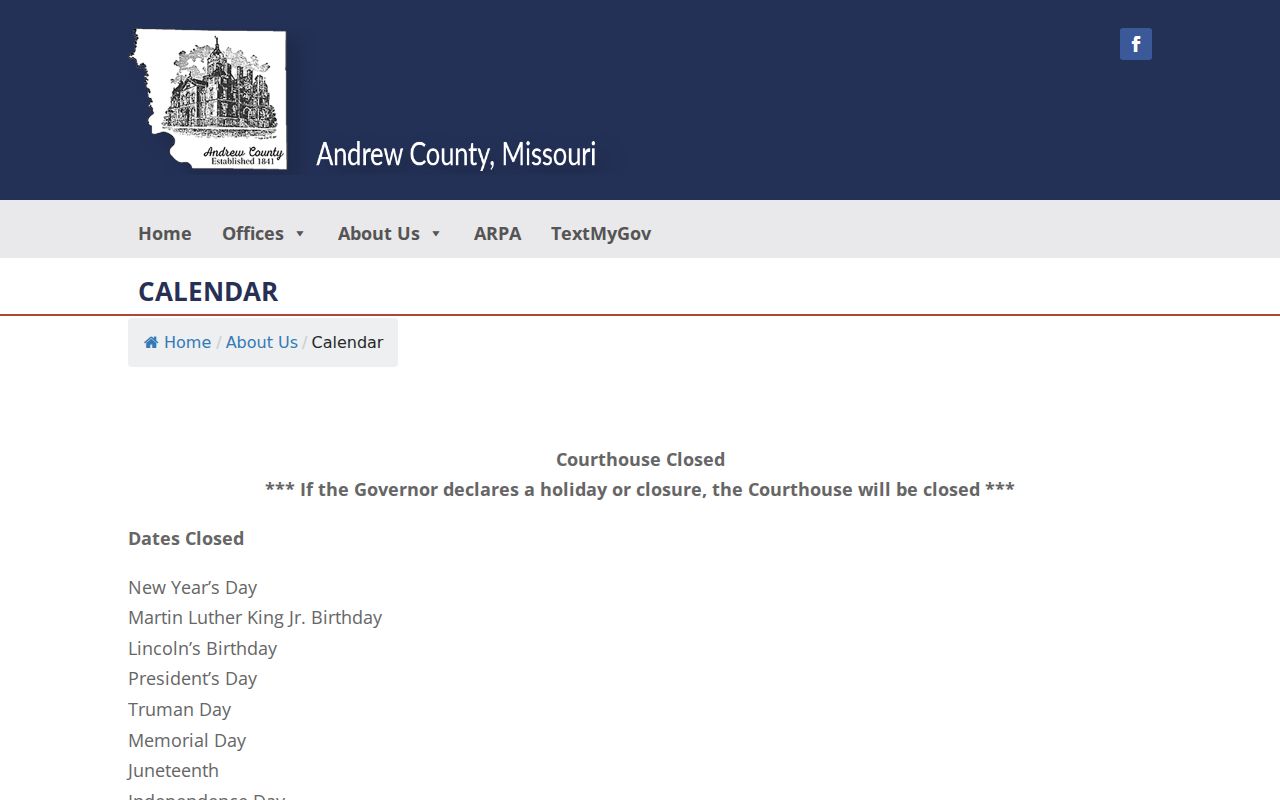
Official closure information helps you avoid one common mistake. That mistake is treating a county-office schedule as the live status of an Andrew County court calendar setting.
Note: Court holidays, local rule updates, and administrative orders can each change on their own, so confirm a setting close to its listed date.
Two more official operations sources exist. The Fifth Circuit administrative-orders repository and its announcements page can explain a procedural change. A court-wide notice can appear there too. Neither one replaces the case-specific scheduled-hearing entry. When a notice looks relevant, match it to the case number. Then confirm with the clerk instead of assuming it applies to every docket.
What To Do If You Miss a Setting
Start with Case.net. Look up the current docket event there. Then contact the Andrew County Circuit Clerk promptly to ask whether the case has a new setting or an entered order. Missing a court date carries consequences. They vary with the case type, the court's order, and where the case stands procedurally. Trust the official docket and the clerk's confirmation over a recurring calendar pattern or a hearing line you saved earlier.
Missed a setting? A missed appearance can lead to a failure-to-appear entry, a warrant, a bond consequence, or another court action depending on the case. Contact the clerk and, where applicable, a licensed attorney promptly for the correct next procedural step. Do not assume a new date exists until the court record or clerk confirms it.
Andrew County Court Calendar Attendance Limits
The Fifth Circuit local rules lay out remote-video procedures for eligible civil victims and testimony. Those rules cover notice, an affidavit, the Webex device, early arrival, and limits on recording. They do not create a general right to attend every proceeding by video. Before you plan to attend, ask the clerk whether the specific hearing is public, remote, hybrid, sealed, or otherwise restricted.
The official Andrew County courthouse directions identify the county's courthouse location and travel route.
Directions help you find the building. The Andrew County court calendar record itself still controls the key facts. It sets the date, the division, and whether a hearing is open to the public.
Public attendance can also turn on courtroom capacity, security procedures, and rules against recording. Those practical details never change the docket itself. Confirm them with the clerk before you arrive. This matters most for a proceeding involving protected records or a recently changed setting.